06 August 2011

Near Marshall, California on Tomales Bay is the Marconi Conference Center State Historic Park, on the site of Guglielmo Marconi's Marshall Receiving Station, where trans-Pacific wireless communication signals were received. This concrete block anchored guy wires that held in place one of the tall receiving antenna for the station. The antenna are no longer present; these concrete blocks are one of the few infrastructural remnants of the wireless station. Without the innovation of Marconi and other early wireless communication engineers, our contemporary world of instantaneous, digital and mobile communication would not be the same. This historic location is now a conference center, and any memory of its original use is relegated to photographs and written description. This photo taken by the author, January 2011. I plan on writing more about the space of Marconi's wireless infrastructure soon.


My two blogs, Pockets of Space and Everyday Structures, have now both been mentioned at Things Magazine in the last six months. As I wrote in April regarding Pockets of Space, it is always rewarding to have your work mentioned on websites you actually read, in this case the only meta-blog I regularly follow. Again, thanks for the mention at Things Magazine.

04 August 2011

preparing the street for new fiber optic cables

Lombard Street in the low 20s, Center City Philadelphia. Near the AT&T communication facility at 500 S. 27th St it appears that AT&T and Verizon-in the center of the photograph you can just make out 'VZ' spray painted in orangeis going to be cutting up the asphalt to put down new fiber optic communication cables. The neighborhood is full of these markings from AT&T, Verizon, and Level 3; I am assuming new communication systems are entering Center City, emerging out of the AT&T communication facility at the corner of 27th Street and South Street.

14 July 2011

Where Google Maps Street View comes from. Caught in action 25th and Spruce, Philadelphia.

louvered box

Philadelphia, above the Delaware Expressway.

08 June 2011

convergence

On the Schuylkill Trail near Norristown, there is a electrical utility line that supports a cellular phone antenna site for AT&T - the communication infrastructure at the base of the pole has AT&T branding on it. This location illustrates well the convergence of multiple infrastructure networks, and the co-location of one utility atop another. We have two electrical systems in view, with the line in the center-left of the photograph and more in the background, a railroad track on the left, and the Pennsylvania Turnpike passing overhead. AT&T's cellular antenna is most likely located where it is to support people talking while driving on the turnpike, not for cyclists or pedestrians on the Schuylkill Trail.

23 May 2011

a definition of infrastructure

Sanford Kwinter's Requiem for the City at the End of the Millennium (Actar, 2010). For a fuller look at of the collection of essays, see Dan Hill's post at City of Sound


Sanford Kwinter provides a long, winding, but useful definition of what infrastructure is, in his chapter "Urbanism, an Archivist's Art?", on page 59 of the above-mentioned text:

By "infrastructure" one means every aspect of the technology of rational administration that routinizes life, action, and property within larger (ultimately global) organizations. Today it can be argued that infrastructures own a little part of everything. Infrastructure includes the systemic expression of capital, of deregulated currency, interest rates, credit instruments, trade treaties, market forces, and the institutions that enforce them; it includes water, fuel, and electrical reservoirs, routes, and rates of supply; it encompasses demographic mutations and migrations, satellite networks and lotteries, logistics and supply coefficients, traffic computers, airports and distribution hubs, cadastral techniques, juridical routines, telephone systems, business district self-regulation mechanisms, evacuation and disaster mobilization protocols, prisons, and subways and freeways with their articulated connections; it includes libraries and weather-monitoring apparatuses, trash removal and recycling networks, sports stadiums and the managerial and delivery facilities for the data they generate, parking garages, gas pipelines and meters, hotels, public toilets, postal and park utilities and management, school systems and ATM machines; it covers celebrity, advertising and identity engineering, rail nodes and networks, television programming, interstate systems, entry ports and the public goods and agencies associated with them (Immigration and Naturalization Service, National Security Agency, Internal Revenue Service, Food and Drug Administration, Bureau of Alcohol Tobacco and Firearms); it comprises sewers and alarms, the multitiered military-entertainment apparatus, decision engineering pools, wetlands and water basins, civil structure maintenance schedules, epidemiological algorithms, cable delivery systems, police enforcement matrixes, licensing bylaws, greenmarkets, medical-pharmaceutical complexes, internet scaffolds, handgun regulations, granaries and water towers, military deployment procedures, and street and highway illumination schemas; in short, infrastructure concerns regimens of technical calculation of any and all kinds. 
Kwinter's point is useful, that infrastructure is embodied in everything we use - that infrastructural systems touch all aspects of life today, from the scale of the individual to the globe.

exposed: #2 in a series

Corner of Cecil B. Moore Ave. and N. 13th St. Temple University, North Philadelphia.

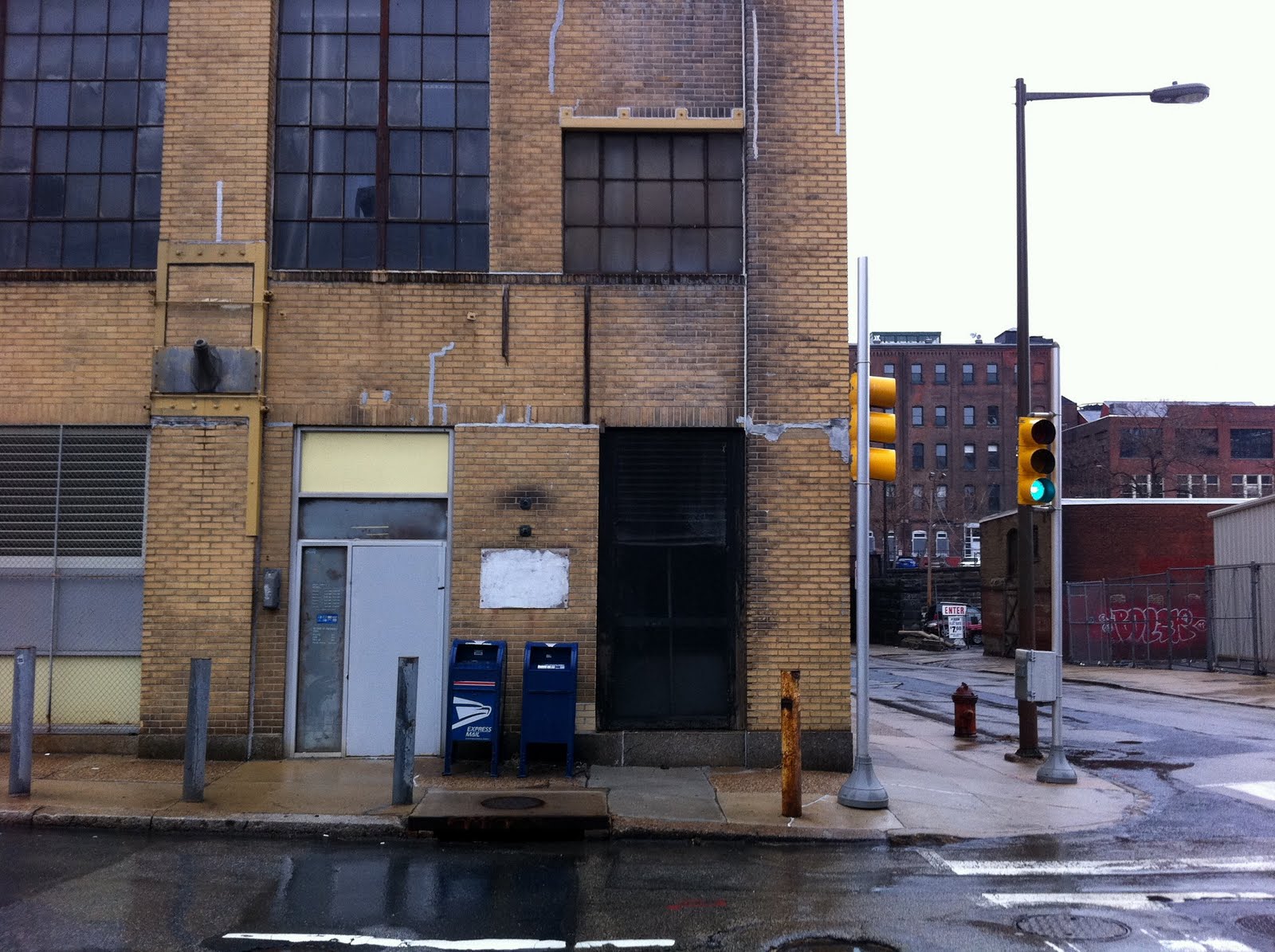
a USPS facility on the back of a data center

Callowhill and N. 13th St., North Philadelphia. Spring 2011.


Terminal Commerce Building's eleven story high, square-block of data center space at 401 North Broad houses a small post office on the building's backside. After some brief research online, I am not sure if the post office is still in use. Likely the postal facility is a throwback to the building's original use as a furniture wholesale warehouse (click the first link above for more information). Even if the facility is still in use, I doubt this post office sees as much foot traffic today as it did when the building provided space for physical, tangible goods.  This shuttered post office provides an instance of one of the many juxtapositions present in our lives today, where the immaterial connections to other people and places provided through technologies such as a mobile phone and the Internet are more present than the physical connections maintained through a post office and the mail system. This small post office on the backside of the Terminal Commerce Building situates in one location two communication systems: the physical presence of a digital node in the Internet's infrastructural backbone, and a node in the USPS's mail distribution and logistics infrastructure.

19 May 2011

AT&T fiber travelling alongside the Amtrak corridor

Woodland Cemetery, West Philadelphia. The wooden marker with the number 5 on top marks an AT&T fiber optic communication cable, possibly the one that travels between Washington DC and Boston. A map of this system is at the long-lines.net website here.   

18 May 2011

exposed: #1 in a series

South Broad Street, Philadelphia.